...
International
Disaster Information Network (IDIN)
Coordinated
in
conjunction with the Global
Preparedness & Response Network
.
Contact:
Stephen
M. Apatow
Founder,
Director of Research & Development
Humanitarian
Resource Institute (UN:NGO:DESA)
Humanitarian University
Consortium
Graduate Studies
Center
for Medicine, Veterinary Medicine & Law
Phone: 203-668-0282
Email: s.m.apatow@humanitarian.net
Internet: www.humanitarian.net
H-II OPSEC
Url: www.H-II.org
In 1999,
Humanitarian
Resource institute initiated the IDIN
project in
cooperation with the FEMA
Preparedness, Exercises & Training
Directorate, building upon the
foundation established by the U.S. State
Department plans for a Global Disaster
Information Network (GDIN)
in
the early 90's.
The IDIN global communication network
included
leaders in approximately 200 United
Nations member countries,
corporate, inter-governmental, non
governmental, community action, interfaith
organizations and
media (newspaper,
radio and television networks).
These resources were utilized
to
support contingency
planning
for the Year 2000 conversion.
In
response to the needs presented by FEMA,
Humanitarian Resource
Institute established a rapid
response plan for (1) infrastructure
analysis in each country, (2)
assessment of NGO's and relief
organizational capacity to address the
size and scope of humanitarian needs, (3)
the provision of data to
enhance the strategic planning, project
development and allocation of
financial and inkind donations.
After
20 years of advocacy and policy
development work through Humanitarian
Resource Institute (UN:NGO:DESA), the
Humanitarian
Intervention Initiative (H-II) was
established to support strategic
planning, development and stabilization of
humanitarian emergencies
that were beyond the operational
capacities of the United Nations,
non-governmental and relief organizations.
This included optimization
of defense logistics and resource
capabilities, as well as expanding
special protective forces for humanitarian
operations, through H-II
OPSEC.
Beyond
social media, Humanitarian
Resource Institute specializes in research,
identification of the
target audience and effective integration of
resources such as
telecommunications, direct mail, newspaper,
radio, television and
Internet to achieve our communications
objective. Networks
include:
- newspaper,
radio and television, corporate,
intergovernmental, non-governmental,
United Nations, community action and
interfaith organizations in
approximately 195 countries.
- grassroots
networks (household level), corporate,
municipal, state and federal
government, community action and
interfaith organizations in
approximately 3100 United States Counties.
The
Humanitarian University
Consortium (ProMED:ISID:
Announcements
2003 (08): Humanitarian Univ. Consort.) was
founded to
support the development of initiatives
associated with economic,
social, cultural and humanitarian issues
worldwide. Our mission
is to serve as (1) an
international community of scholars, (2) a
bridge between Humanitarian
Resource
Institute and the international academic
community, (3) a think tank in
support of the United Nations programs and (4)
the promotion of higher
learning
through both traditional and distance
education.
In The Spotlight
Related
- Humanitarian Early
Warning Service (HEWS): Rome
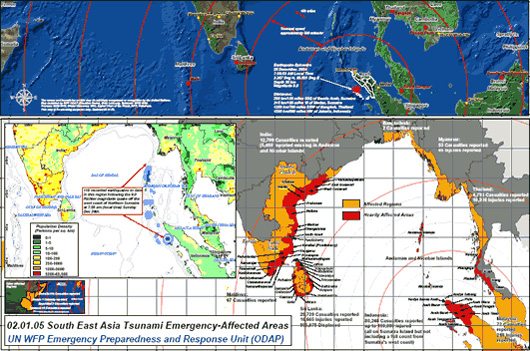
- As of 31 December 3:00
p.m.(GMT+1), the death toll from the Asian
tsunami has passed 135,000.
More
than 5 million people are reported
homeless with expectations that
these numbers will continue to rise.
26 December 2004:
Humanitarian Resource Institute International
Disaster
Information Network
activated .
Biodefense
Resources
..
...
|
.
.
.
|