Global Preparedness & Response Network
Resources for Strategic Planning & Project Development
The Global
Preparedness & Response Network is a collaborative initiative of
international medical, veterinary and scientific experts to share
information and enhance academic discussion of issues associated with
preparedness, response, mitigation and policy. ... ... ... ... ... ... ... ... ... ...... ... ... ...
... ... ... ... ... ...
Contact:
Stephen
M. Apatow
Founder,
Director of Research & Development
Humanitarian
Resource Institute (UN:NGO:DESA)
Humanitarian University
Consortium Graduate Studies
Center
for Medicine, Veterinary Medicine & Law
Phone:
203-668-0282
Email:
s.m.apatow@humanitarian.net
Internet:
www.humanitarian.net
.
In The Spotlight:
- Emergency
Care Center - Tools for medical self care in a large scale natural disaster,
infectious disease or terrorist incident. Humanitarian University
Consortium.
|
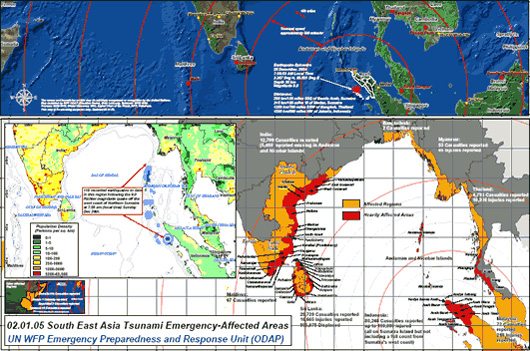
27 December 2004: Stephen Apatow
gathers data accurate projections regarding the death toll/damage
assessment in southern Asian coastlines (in nine countries) impacted by
the tsunami. Accurate statistics were crucial to background discussions
with leaders in UN member countries (HRI: International Disaster
Information Network) to prompt an appropriate international relief
effort in this region of the globe.
The
scale of this disaster is Asia, just touches the surface regarding the
complexity of issues facing geographic areas with large impoverished
populations, with military conflicts where the governments do not
maintain control of the
area impacted by the disaster. Current discussions include the
inability for relief workers and aid organizations to reach many areas,
prompting
the possible need for peace keeping troops supported by NATO.
|
- Humanitarian Early
Warning Service (HEWS): A global multi-Hazard watch service to
support humanitarian preparedness. HEWSweb has been conceived as the
first global one-stop shop for early warning information, to facilitate
access to the latest early warnings by bringing together and
rationalizing under one platform the vast amount of information now
available on the Internet from multiple specialized institutions.
- SAMHSA:
Coping with Violence and Traumatics Events: USDHHS.
Terrorism:
Cyberterrorism:
Emerging
Infectious Diseases:
Chemical & Hazardous
Materials Risks
 Looking
Back at Bhopal: Just after midnight on December 3, 1984, a
pesticide plant in Bhopal, India accidentally released approximately 40
metric tons of methyl isocyanate into the atmosphere. The incident was
a catastrophe for Bhopal with an estimated 2000 casualties, 100,000
injuries, and significant damage to livestock and crops. The long-term
health effects from such an incident are difficult to evaluate; the
International Medical Commission on Bhopal estimated that as of 1994
upwards of 50,000 people remained partially or totally disabled....
Wickpedia. Looking
Back at Bhopal: Just after midnight on December 3, 1984, a
pesticide plant in Bhopal, India accidentally released approximately 40
metric tons of methyl isocyanate into the atmosphere. The incident was
a catastrophe for Bhopal with an estimated 2000 casualties, 100,000
injuries, and significant damage to livestock and crops. The long-term
health effects from such an incident are difficult to evaluate; the
International Medical Commission on Bhopal estimated that as of 1994
upwards of 50,000 people remained partially or totally disabled....
Wickpedia.
Radiological Emergency Preparedness
Severe Weather: Preparedness Resources
. |
.
|